Technique · 23 April 2026
Frenzel equalisation for spearos: the only technique that scales past 15 metres
Step-by-step guide to the Frenzel equalisation technique for spearfishing. Why it matters, how to learn it, and the drills that make it automatic.
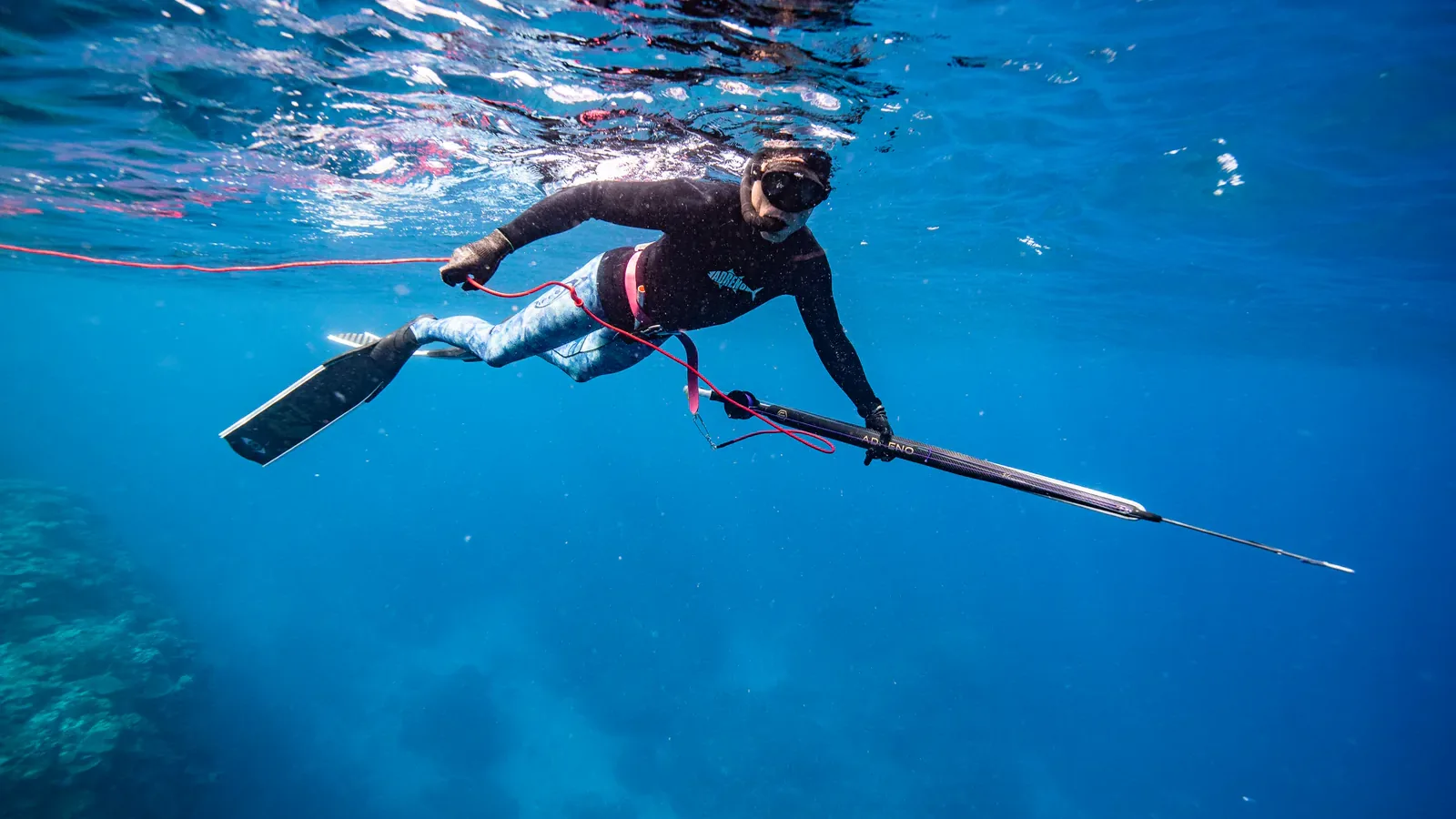
Frenzel equalisation for spearos: the only technique that scales past 15 metres
Every new spearo who plateaus at 10-12 metres hits the same wall: Valsalva equalisation. It works at shallow depth, but past 15 m your lungs no longer have enough residual air to push through your sinuses, and you stop being able to equalise. Frenzel is the fix. It’s also the technique every freediving instructor will drill for three days before they let you go deeper than you’ve been.
This is the practical guide to learning Frenzel as a spearo.
The short version
- Valsalva = pushing air from your lungs. Works shallow, breaks down past 15 m.
- Frenzel = pumping air from your throat using your tongue and soft palate. Works to any depth.
- Frenzel is learnable in one afternoon but takes weeks of reps before it becomes automatic.
- Essential for anyone diving past 15 m, which is all but the most casual Thai reef hunters.
- Formal instruction beats YouTube: Apnea Total Level 2 covers it in structured progression.
Why Valsalva fails at depth
When you dive, water pressure compresses your lungs. At 10 m, lungs are half their surface volume. At 20 m, they’re a third. At 30 m, they’re a quarter.
Valsalva works by pushing air from your lungs up through your Eustachian tubes into your middle ear. Shallow, you have plenty of lung air to push. Deep, the residual lung volume is so small that no matter how hard you push, the air doesn’t reach your ears. At that point you stop equalising, pressure builds, ear pain spikes, and you have to abort the dive.
Frenzel solves this because it doesn’t rely on lung push. It uses your tongue as a piston, moving a small reservoir of air already trapped in your throat upward. Lungs are irrelevant.
The four muscles you’ll use
Before the technique, meet the players:
- Soft palate: the squishy muscular bit at the back of the roof of your mouth. You can raise it (to close the nasal passage) or lower it (to open it).
- Epiglottis: the flap at the top of your throat that closes your trachea (windpipe) when you swallow. You can hold it closed voluntarily.
- Tongue root: the back third of your tongue. Used as the piston.
- Jaw: supports the whole system.
Learning Frenzel is largely learning to isolate and control these four muscles.
The dry practice sequence
Do this on land, no water involved. Ten minutes per session, once or twice a day for two weeks.
Step 1 — Find your soft palate
Say “kuh” (the hard K sound). That’s your soft palate raising. Say “nguh” (like the “ng” in “sing”). That’s your soft palate lowering.
Practice switching: kuh-nguh-kuh-nguh. Slow. Keep your mouth closed while you do it so the movement is purely the soft palate.
Step 2 — Close the epiglottis
Pinch your nose. Close your mouth. Try to breathe out through your nose while pinching it — you’ll feel pressure. Now try to breathe out while keeping your throat relaxed but closed (as if trying to swallow without actually doing it). That closed throat is your epiglottis.
You should be able to close the epiglottis while your soft palate is raised (air in sinuses, air in mouth, throat shut).
Step 3 — The tongue piston
Pinch your nose. Close your mouth. Close your epiglottis (step 2). Fill your mouth with a small bubble of air.
Now, press the back of your tongue upward against the roof of your mouth. The bubble of air trapped in your mouth has nowhere to go except into your nasal passage.
That’s Frenzel. The pressure spike in your nasal passage pushes through your Eustachian tubes and equalises your ears.
If you did it right, you should hear or feel a little “pop” in each ear.
Step 4 — Combine
- Pinch nose.
- Close epiglottis.
- Pump tongue back and up.
- Feel ears pop.
Repeat 20 times per session. It’ll feel weird at first. Within 10 sessions it starts to feel natural.
In-water transition
Once dry Frenzel feels automatic, take it to the pool or shallow water.
- Start at 3-5 m depth. Equalise with Frenzel every metre.
- Progress to 8-10 m. Equalise every half-metre on descent.
- At 15 m+, equalise continuously — small pulses.
Never force Frenzel against resistance. If your ears don’t pop on the first pulse, stop descending, come up half a metre, and try again. Descending against a blocked Eustachian tube is how you rupture your eardrum.
Common mistakes
- Pushing with lungs instead of tongue. You’re reverting to Valsalva. Slow down, focus on the back-of-tongue lift.
- Not closing epiglottis. Air escapes back down the throat instead of into sinuses. Practice dry.
- Equalising too late. By the time you feel ear pressure, it’s too late to Frenzel comfortably. Equalise every half-metre from 10 m onward.
- Holding breath with tight throat. The glottis should be closed, not clenched. There’s a difference.
How this matters for spearfishing
For reef hunting at 5-10 m, Valsalva is enough. No urgency to learn Frenzel.
For everything else — mid-range jacks at 12-15 m, pelagic ambush at 18-22 m, dogtooth pinnacle work at 25 m — Frenzel is mandatory. You cannot progress past the beginner ceiling without it.
Where to learn properly
Dry practice gets you 50% of the way. The other 50% needs in-water instruction with a coach. The Apnea Total Level 2 course on Koh Samui covers Frenzel mastery explicitly over 3 days. 12,000 THB. Small groups.
You can supplement with our dry breath-hold trainer — CO2 and O2 tables build the breath-hold headroom you need to practice equalisation drills without running out of air.
One honest note
Some people get Frenzel in a single afternoon. Others take 3-4 weeks of daily practice. If you’re in the second group, don’t get discouraged — you’re not worse at freediving, you just have a slightly different proprioception profile. It clicks eventually. Everyone’s click happens at a different session.
Got questions about gun choice for depths where Frenzel matters? WhatsApp me with your current dive comfort zone — I’ll tell you what gun makes sense to grow into.
Frequently asked
What is Frenzel equalisation?
Frenzel is a hands-free equalisation technique where you use your tongue and soft palate to pump air from your throat into your Eustachian tubes. Unlike Valsalva (pushing air from the lungs), Frenzel works at any depth because it doesn't rely on lung volume.
Why does Valsalva fail past 15 metres?
At 15 m your lungs are compressed to roughly a third of surface volume. Valsalva needs lung air to push through to your ears; past 15 m there isn't enough residual volume left. You can push as hard as you like and the air no longer reaches your middle ear.
How long does it take to learn Frenzel?
The mechanics are learnable in one afternoon. Making it automatic under pressure (on a dive, while hunting) takes weeks of daily reps on dry land first, then wet training. Most spearos underestimate the time from 'can do it dry' to 'don't think about it at 20 m'.
Do I need Frenzel to spearfish in Thailand?
If you're diving shallow Koh Samui reefs at 5-10 m, Valsalva is fine. Past 15 m, which is any Andaman Sea bluewater work, any Similans trip, or hunting tuna and wahoo, Frenzel is non-negotiable. Valsalva users simply can't reach those depths safely.
Can I learn Frenzel from YouTube videos?
You can learn the mechanics, but structured instruction catches errors you can't self-diagnose, notably soft-palate lock and tongue position. Apnea Total Level 2 at Freediving Koh Samui includes three days of dedicated equalisation drills.
What is the difference between Frenzel and Mouthfill?
Mouthfill is an advanced version of Frenzel used past 30 m. You fill your mouth with air before the lungs compress too far, then Frenzel from the mouthfill. Most recreational spearos never need it. Frenzel alone gets you to 25-30 m.
Published 23 April 2026 · Diego Pauel · Technique
equalisationfrenzeltechniquetraining
Keep reading
You might also like.
Technique
Ikijime and bleed-out: how to humanely dispatch a speared fish (and get better meat)
Humane fish dispatch for Thai spearos. How ikijime works, why it makes the meat measurably better, and the one tool ever…
Technique
Snapper hole-hunting: the technique that fills Thai dinner tables
How to spear snapper on Thai reefs. Hole-reading, approach angles, and the gun setup that works on the 1-3 kg class that…
Technique
Pencil point sharpening — Rob Allen's method for Thai reef species
Every missed reef shot rolls your spear tip. Rob Allen's 2024 pencil-point sharpening method, applied to the Thai specie…