Species · 22 April 2026
Dogtooth tuna spearfishing in Thailand: where, how, and with what gear
Real guide to dogtooth tuna spearfishing in Thai waters. Where to find them (and where you legally can), the gear that actually lands fish, and the brutal truth about dive depth.
Dogtooth tuna spearfishing in Thailand: where, how, and with what gear
Dogtooth tuna is the fish every Thai spearo eventually wants to land. Torpedo-shaped, reef-associated, and strong enough to strip a reel spool faster than you can close the gap. They are not uncommon in Thai waters — but they are uncommonly well-protected by the geography of where they hold and the legal status of those places. This is the honest guide.
For the broader legality rules, read our legality and marine parks guide first. Every word below assumes you already know to stay out of protected waters.
The short version
- Where: outer reef pinnacles and drop-offs. Most productive spots sit inside marine parks (Similan, Surin, Koh Rok) where spearfishing is banned. Legal alternatives exist around southern Phuket, offshore Koh Racha Noi (outside park), and deeper Chumphon/Koh Tao offshore pinnacles in the Gulf.
- Size class: 5-20 kg on the reef. 30-50 kg fish are specialist offshore targets requiring proper bluewater rig.
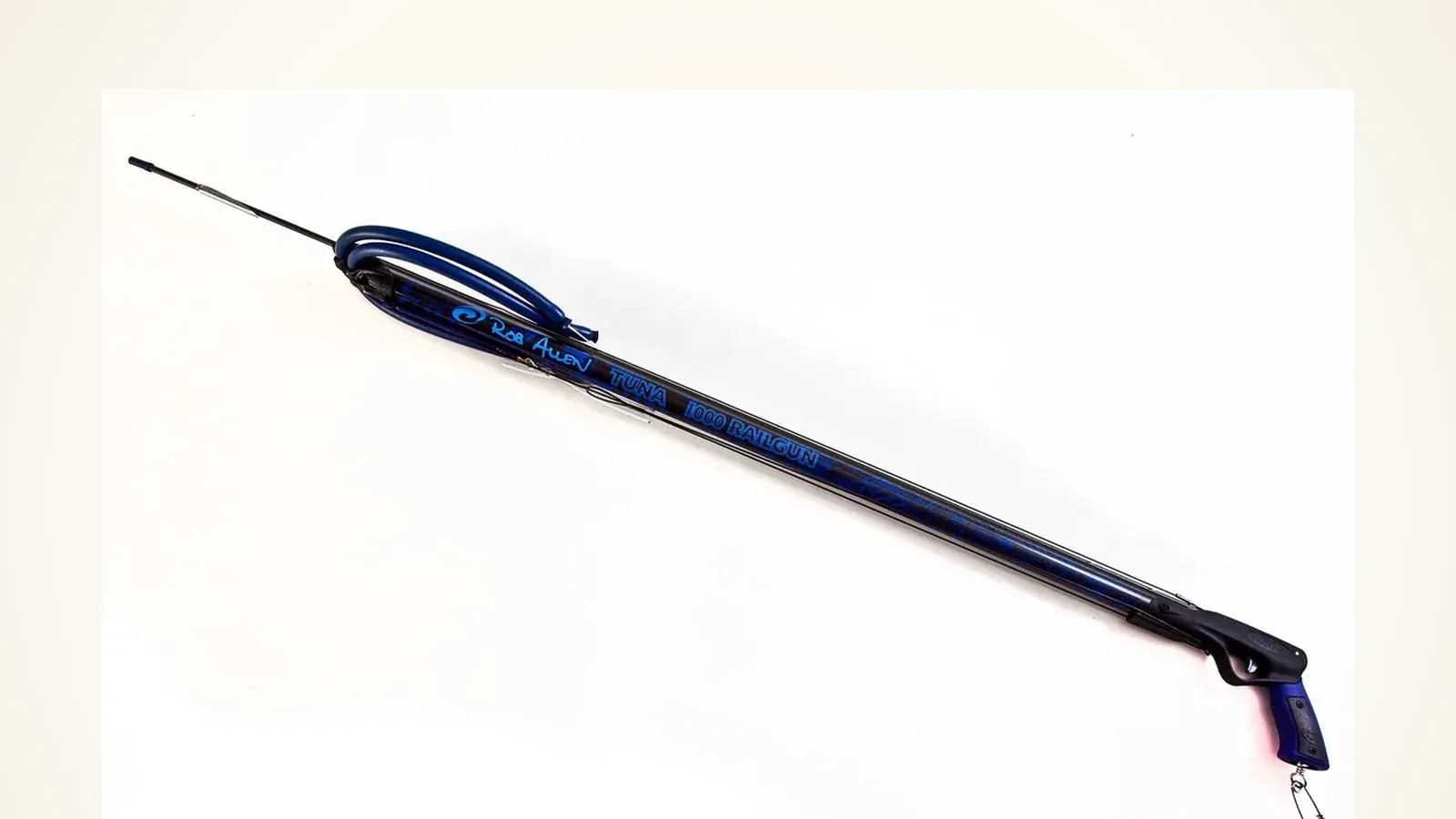
- Gun: 1 m+ Snapper or Tuna Railgun, double 16 mm rubber, 7.5 mm shaft with slip tip for the big class.
- Technique: ambush at the thermocline or on the drop, not chase at depth.
- Certification: Apnea Total Level 2 minimum — this is not beginner territory.
What makes dogtooth fighting-hard
Dogtooth have three characteristics that make them different from regular yellowfin or smaller tuna:
- They hold deep. Typical ambush depth is 15-25 m. A good dogtooth dive is deeper than most spearos are trained for.
- They power downward, not out. When shot, they drive for the reef and wrap your line on coral. Unlike yellowfin which run horizontal, dogtooth sink and head for structure.
- Their jaws. Dogtooth teeth are not decorative. They cut shooting line, fray wishbones, and snap monofilament. A braided or UHMPE shooting line is essential.
This is why the gear recommendations below are not the same as what works on reef fish or even mid-range pelagics. Dogtooth need commitment.
Where you can legally spearfish for dogtooth
Most of Thailand’s famous dogtooth spots are inside marine parks and off-limits:
- Similan National Marine Park (Andaman) — home to the highest-density dogtooth population but completely closed to spearfishing.
- Surin Marine Park — same.
- Mu Ko Koh Rok — same.
- Ang Thong (Gulf) — same.
Legal alternatives that actually hold fish:
- Southern Phuket offshore pinnacles — specifically outside the Laem Panwa / Racha park boundaries. Ask a charter for specific GPS, as lines shift.
- Koh Racha Noi — outer edges outside the park boundary. The southern drop-off is legal and productive.
- Offshore Chumphon / Koh Tao pinnacles — the Gulf holds fewer but bigger dogtooth than the Andaman. Specialist knowledge required.
- Ranong offshore (far north Andaman) — fewer marine park boundaries, but conditions can be rough.
For any of these, you need a charter. Do not attempt solo. The legal pinnacles are hours offshore.
Gear that works
Dogtooth require a step up from your reef kit. You are not going to land one with an 80 cm Snapper. Real numbers:
Speargun
- Entry target (5-15 kg dogtooth): 1 m Snapper Railgun with single 16 mm rubber, 7 mm shaft with bi-flopper. Handles mid-class fish in the 15-25 m range.
- Serious target (15-30 kg): 1.1-1.2 m Railgun with double 16 mm, 7.5 mm shaft, slip tip.
- Big class (30 kg+): 1.3 m+ with double 18 mm (careful of loading load), 7.5-8 mm slip-tip shaft, reel mounted.
Browse our speargun range — I stock everything from 75 cm Snappers to the 1.2 m Pacific Railguns.
Rubber + shaft
For dogtooth work you want full power. Use our rubber and shaft calculator to spec the rubber length and stretch target correctly — there’s no room for error at this level.
Line + reel
- Shooting line: 2 mm UHMPE, 4-5 m of it, no monofilament.
- Reel: 40-60 m Vecta belt reel mounted on the gun. Bluewater-grade.
- Float: 12 L rigged float with flag (for dive-buddy visibility) + 30 m UHMPE line.
- Slip tip: bi-flopper for smaller class, single-flopper slip tip for 20 kg+.
The bluewater rig
If you’re going after dogtooth specifically, our Bluewater Rig bundle is the right-priced kit — saves 15% and includes the right gun + float + line + reel + fins for this work.
Technique — the real answer
Most dogtooth come from ambush, not chase. Here’s the honest play:
1. Find the right pinnacle
Local knowledge trumps everything. The pinnacle needs: current breaking over the top, food source (baitfish schools or shrimp on the structure), and 20-30 m depth maximum for the top of the structure. A pinnacle that comes within 10 m of the surface is often better than one that bottoms at 40 m.
2. Position on the down-current side
Dogtooth hunt into the current. Position yourself at the down-current edge of the pinnacle at about two-thirds of the depth (if the pinnacle tops at 20 m, position at around 15 m on descent). Let yourself sink — minimal fin movement, silent dive.
3. Arrive, then wait
Dogtooth are curious but not stupid. If you arrive with a descent and start looking around aggressively, they stay 20 m away. Arrive, settle behind the rock edge, and wait 20-30 seconds. That’s when they cruise by to inspect.
4. Shoot early
First shot, best shot. Dogtooth at 8-10 m is a possible shot. At 6 m they are already past you. If your gun is 1 m, that means you have about a 4 m realistic kill zone. Measure with your eye, not your gut.
5. Shot placement
Behind the pectoral fin, through the lateral line. A spine shot paralyses the fish instantly — a lung shot runs it straight into the reef. Do not shoot at the head. Dogtooth skulls are bulletproof.
6. Fight strategy
The moment you shoot, kick for the surface. Do not fight the fish at depth — you will lose. Get to the float, let the reel take the first run, and play the fish from the surface. This is why the reel is non-negotiable. Free-shooting a dogtooth is how spearos lose guns.
When to pass
You see a 10 kg dogtooth at 22 m and your static PB is 2:00. Pass the shot. The dive to recover the fish plus the fight is more than you have in the tank. Dogtooth will kill you if you are greedy. Better to watch it go than to be the story.
Training requirements
Before your first dogtooth hunt:
- Apnea Total Level 2 certification completed
- Consistent 25 m depth, comfortable
- Static apnea at 3:00+ dry, 2:30+ post-dive tension
- Dynamic pool work so your finning is efficient
The Static Apnea Clinic on Koh Samui is purpose-built for this progression.
One honest note
Thailand is not the Maldives for dogtooth. The density is lower, the legal access is harder, and the fish tend to run smaller than in the Indian Ocean proper. If dogtooth is your singular target, Thailand is a warmup — the real season happens in Malaysia, Seychelles, or the Indian atolls.
But if you are already hunting in Thailand and want to step up from reef fish to pelagic, dogtooth is the right progression target. Patient, gear-appropriate, and properly trained — you will land one.
Got a specific pinnacle or trip to plan? Message me on WhatsApp and I’ll tell you what legal access looks like for the coast you’re based on.
Published 22 April 2026 · Diego Pauel · Species
dogtooth tunabluewaterandamanspecies
Keep reading
You might also like.
Species
Wahoo spearfishing in the Andaman: fast, legal-limited, and rarely landed
Wahoo spearfishing tactics for Thai bluewater. Where they show up legally in the Andaman, how to read the current lines,…
Species
Giant trevally spearfishing in Thailand: the reef's heaviest hitter
GT spearfishing tactics for Thai waters. Where they show up, how to position for the window, and the gear that actually …
Species
Cobia and queenfish in Thai waters: the mid-water surprise species
Cobia and queenfish spearfishing in Thailand — two opportunistic mid-water targets that reward a gun raised at the right…