Species · 22 April 2026
Cobia and queenfish in Thai waters: the mid-water surprise species
Cobia and queenfish spearfishing in Thailand — two opportunistic mid-water targets that reward a gun raised at the right moment. Where they show, shot placement, and why the 90cm Snapper handles both.
Cobia and queenfish in Thai waters: the mid-water surprise species
Neither cobia nor queenfish show up on most Thai spearo bucket lists, but both are landed regularly by hunters who keep their guns up in mid-water. They occupy the same ecological layer, respond to similar structures, and reward the same technique: the spearo who stays loaded, scans mid-column, and shoots without hesitation.
This is the practical guide.
The short version
- Cobia: 3-15 kg typical. Associates with structure — buoys, anchor lines, FADs. Curious, often comes right to the spearo.
- Queenfish: 1-6 kg typical. Nomadic mid-water schooler. Moves fast, bright silver, feeds on baitfish clouds.
- Shared habitat: 5-20 m depth, mid-water column, current-exposed reefs.
- Right gun: 90 cm Snapper Railgun, single 14 mm or double 14 mm, 7 mm shaft with flopper. Same setup handles both.
- Both coasts: Gulf and Andaman hold productive populations. Gulf is more consistent for numbers.
Cobia — the curious predator
Cobia (ปลาช่อน-ทะเล, Rachycentron canadum) are bronze-grey, torpedo-shaped, and often mistaken for small sharks on first glance. They are remora’s larger cousin — a solitary fish that associates with structure and follows larger animals out of curiosity.
Where cobia show up
- Mooring buoys — a spearo classic. Cobia hang under mooring buoys on open water, 5-15 m depth, waiting for passing food. A dive on an offshore mooring often produces a cobia encounter.
- FADs (Fish Aggregating Devices) — anchored floating structures that attract fish. Cobia often hang under or beside them.
- Sunken structure — wrecks, old boats, anchor blocks. Cobia cruise the edges.
- Larger marine life — cobia sometimes follow whale sharks, manta rays, and even large reef sharks. If you see a larger animal pass, scan behind it.
Technique for cobia
Cobia are not spooky. They are curious. This is rare among gamefish and you should exploit it:
- Descend quietly to the structure’s depth. Not deeper — cobia generally hold in the upper-mid column.
- Settle against the structure or just below the buoy. Still, gun up, scanning.
- If a cobia is there, it will often come to you. They circle in for a look, giving you a clean shot at 2-4 m range.
- Shoot behind the pectoral fin through the spine. Their skull is hard — side-spine shots kill cleanly.
Gear for cobia
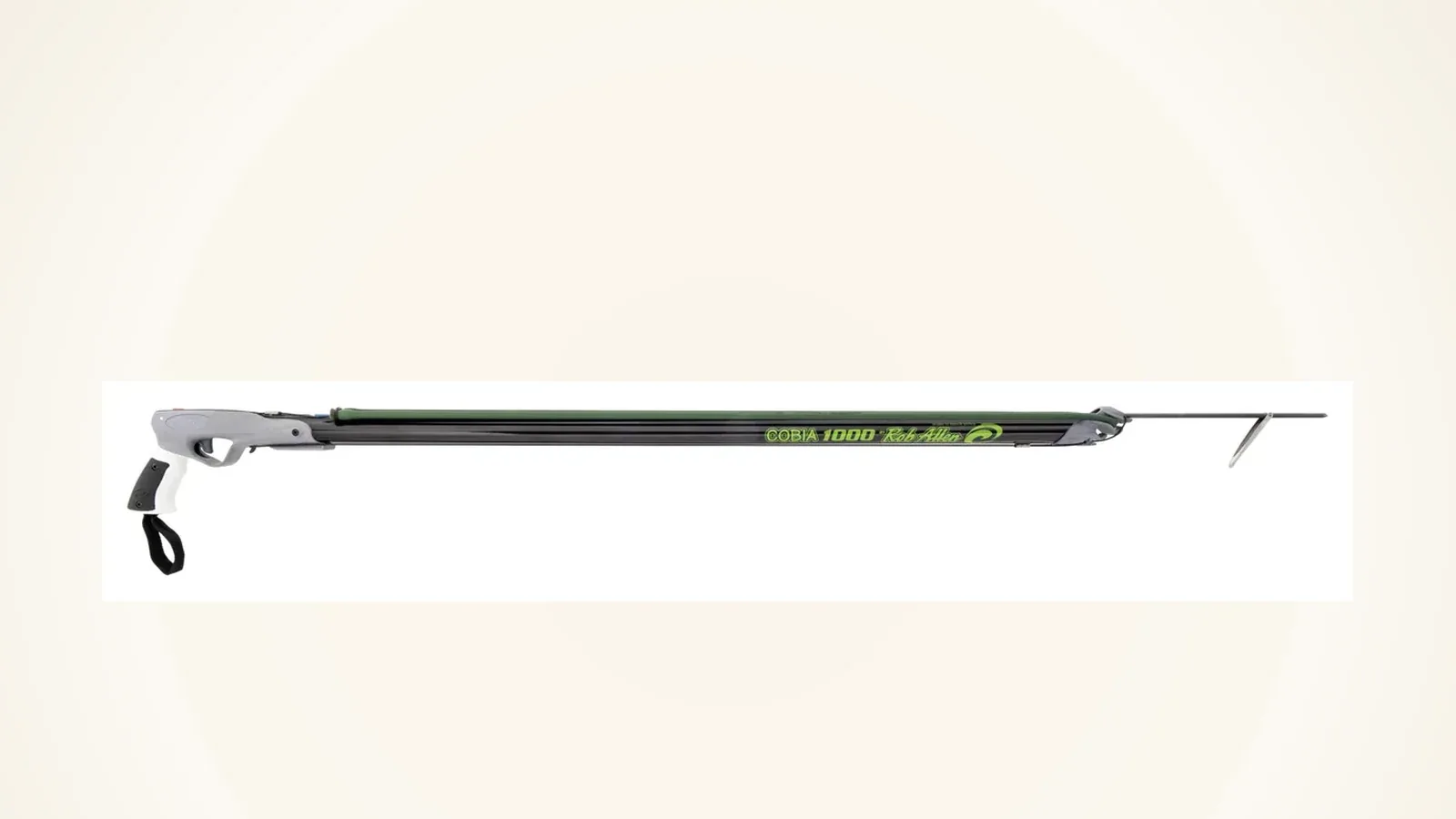
A 90 cm Snapper Railgun with single 14 mm is ideal. You want enough power for a 10 kg fish but not the bulk of a bluewater gun. 7 mm shaft with flopper is standard.
Reel is optional at under 5 kg class. Float + 20 m line is essential above 8 kg because a shot cobia can run hard.
Queenfish — the speed hunter
Queenfish (ปลาสาก, Scomberoides lysan, S. commersonnianus) are flashy silver mid-water schoolers. They feed on baitfish — sprats, anchovies, small fusiliers — and appear in fast, tight schools when bait is concentrated.
Where queenfish show up
- Current lines — visible edges where two water masses meet.
- Baitfish concentrations — if you see a tight cloud of sprats or fry, queenfish may be underneath.
- Shallow reef edges in early morning — 3-8 m depth, high activity at dawn.
- Offshore pinnacles at 8-15 m — secondary but consistent habitat.
Technique for queenfish
Queenfish are fast. You don’t approach them — you intercept.
- Identify a baitfish concentration and position down-current or below it.
- Descend to the queenfish cruising depth (usually 3-8 m) and freeze.
- When the school arrives, pick one fish on the edge. Never shoot into the middle of a school — you either miss or foul-shoot.
- Lead the fish — queenfish move faster than reef species. A 15-20° lead at 4 m range is normal.
- Shoot through the side, behind the gill plate. Spine shot preferred.
Gear for queenfish
Same 90 cm Snapper setup as cobia. Queenfish bodies are thin — a 14 mm rubber with 7 mm shaft is plenty of penetration. Avoid over-gunning — you want a fast-reloading setup because queenfish encounters are often multi-fish opportunities.
The 90 cm Snapper as the mid-water workhorse
For a single-gun Thai spearo covering reef + mid-water species, a 90 cm Snapper Railgun is the correct choice. Reasons:
- Range: effective to 4-5 m, which covers queenfish intercept distance.
- Power: single 14 mm handles 10 kg fish cleanly.
- Reload speed: single-band loads fast on the surface.
- Versatility: also covers hole-hunting grouper and snapper (see our snapper hole-hunting guide and grouper guide).
If you’re new to spearfishing and don’t know what to buy first, the 90 cm Snapper is the right default. The All-Round Hunter Kit bundle pairs it with the mask, fins, belt, float, line, and reel to handle mid-water and reef simultaneously, at 14% off.
Shot placement — a comparison
| Species | Best shot | Avoid |
|---|---|---|
| Cobia | Behind pectoral, through spine | Head-on (dense skull) |
| Queenfish | Side, through gill plate, lead slightly | Tail (thin, tears) |
Both species respond well to spine shots. Neither has the bone density of a large tuna or the fight of a GT — precision placement makes the fight short.
Seasonal timing
Both species are year-round residents in Thai water. Peak activity:
- Cobia: December-March on both coasts. Lower activity during monsoon.
- Queenfish: October-April Gulf, November-April Andaman. Schooling is most predictable in dry-season clear water.
Skip July-September on the Andaman (monsoon). Full calendar: Thailand spearfishing season.
Where to hunt legally
Both species are available on legal Thai coast:
- Gulf mainland (Chumphon, Prachuap) — good queenfish on current edges.
- Koh Samui outside Ang Thong — cobia on moorings, queenfish on baitfish.
- Southern Phuket outside park zones — both species on offshore current lines.
- Krabi mainland outside Hong park — mixed mid-water opportunities.
Full legality breakdown: Legality and marine parks.
Training
Cobia and queenfish are good intermediate targets. Requirements:
- Apnea Total Level 1 complete.
- Comfortable at 10 m depth.
- Static PB 2:00+ dry.
- Basic reef hunting experience before attempting mid-water ambush.
Use our breath-hold trainer to push your PB before stepping up to these species.
Eating note
Cobia is excellent eating — firm, white flesh, often compared to cobia-sashimi quality in fine restaurants. Best grilled with olive oil and salt, or as ceviche if landed fresh.
Queenfish is softer-fleshed, best eaten within 24 hours. Traditional Thai preparation is pla salad — deep-fried crispy with sweet chilli sauce.
Both require ikijime dispatch at the boat — the flesh improves dramatically with proper brain-spike bleed-out over a slow death.
One practical note
Keep your gun up and loaded in mid-water. Most cobia and queenfish shots are missed not because of poor aim but because the spearo had the gun pointed down scanning the bottom when the fish arrived from mid-column. Scanning behaviour matters as much as shooting skill.
Got questions about gun choice for mid-water work? WhatsApp me with your typical dive profile and target species — I’ll tell you whether the 90 cm Snapper is right for you or if you’d be better with something else.
Published 22 April 2026 · Diego Pauel · Species
cobiaqueenfishmid-waterspeciesgulf of thailand
Keep reading
You might also like.
Species
Dogtooth tuna spearfishing in Thailand: where, how, and with what gear
Real guide to dogtooth tuna spearfishing in Thai waters. Where to find them (and where you legally can), the gear that a…
Species
Giant trevally spearfishing in Thailand: the reef's heaviest hitter
GT spearfishing tactics for Thai waters. Where they show up, how to position for the window, and the gear that actually …

Species
Grouper hunting on Thai reefs: patience, precision, and which rock to read
Grouper spearfishing tactics for Thai reefs. Hole-hunting technique, shot placement on hard-skinned fish, and how to tel…