Species · 22 April 2026
Giant trevally spearfishing in Thailand: the reef's heaviest hitter
GT spearfishing tactics for Thai waters. Where they show up, how to position for the window, and the gear that actually handles a 15 kg fish on the reef edge.
Giant trevally spearfishing in Thailand: the reef’s heaviest hitter
Giant trevally — GT, caranx ignobilis — is the fish Thai spearos chase without always expecting to catch. They are ambush predators with a schedule, a mood, and no patience for a poorly-set-up spearo. Landing one is the Thai reef equivalent of a grade. This is the honest playbook.
The short version
- Where: reef edges, current lines, offshore pinnacles. Both coasts, Andaman more consistent. Stay outside marine parks.
- Size class in Thailand: 3-15 kg is typical. 20 kg+ is a great fish. 40 kg+ happens but rarely on spearfishing-accessible coast.
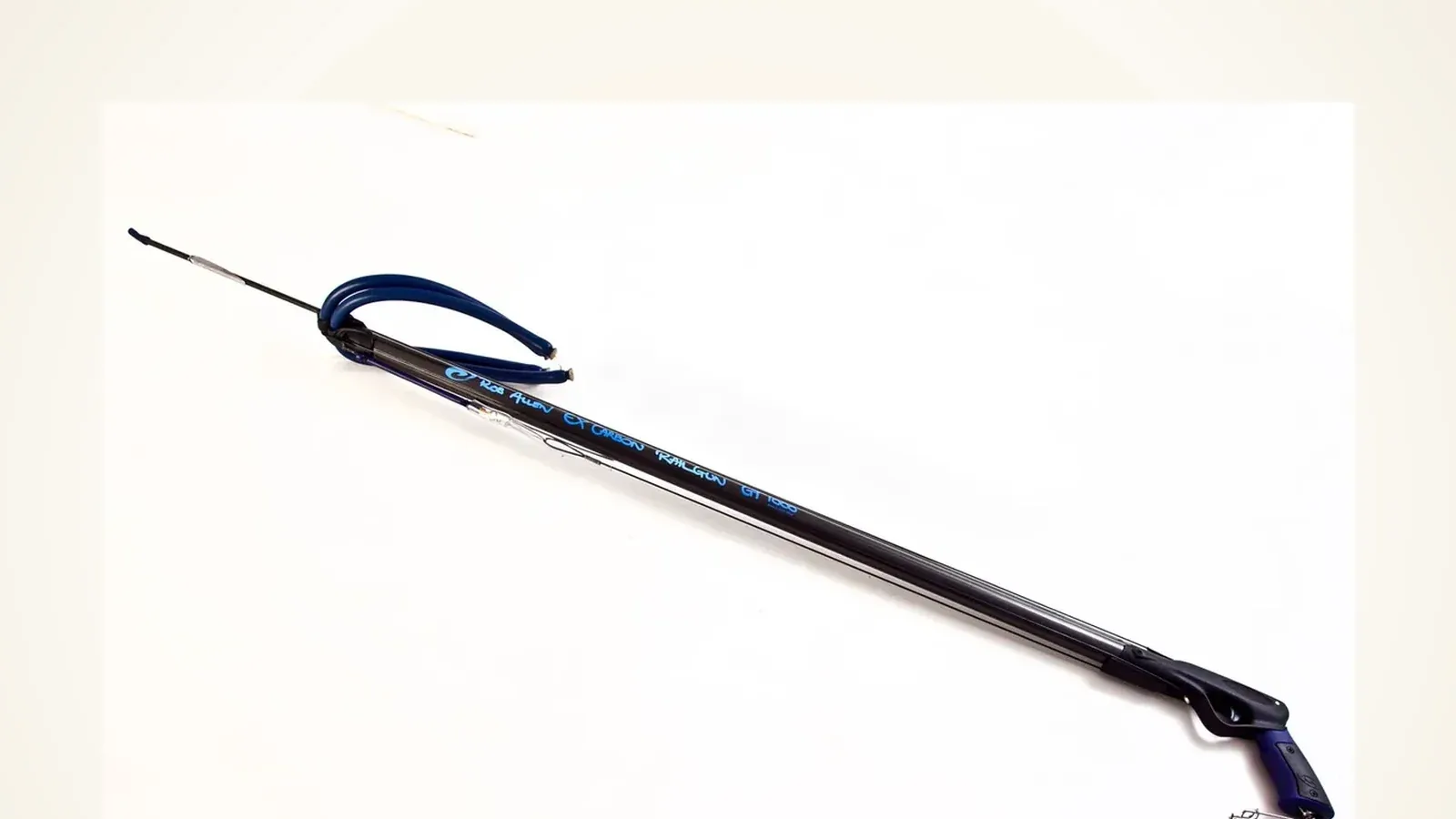
- Gun: 90 cm-1.1 m Snapper or Tuna Railgun, double 14 mm or single 16 mm, 7 mm shaft with flopper. Reel on anything above small class.
- Technique: ambush on the reef edge, not chase. They come to you.
- Legal reminder: most productive GT spots inside marine parks are off-limits. Read legality + marine parks before planning.
Why GT are hard
GT are not shy. The difficulty is different:
- They arrive in a window, not consistently. A GT spot might produce nothing for three dives then deliver six fish in ten minutes. Missing the window is most of what beginners do.
- They charge fast. A GT at 10 m range closes to 3 m in under two seconds. If your gun is not already tracking, you miss the shot.
- They hit hard. A shot GT pulls like a train. Without a reel and float, you lose the gun or the fish or both.
Where GT show up
GT are reef-associated but not reef-bound. They cruise the edges, hunt structure breaks, and respond to baitfish activity.
The hallmarks of a GT spot
- Current break: a reef edge that creates a current shadow. Baitfish cluster in the lee; GT hunt the perimeter.
- Depth change: drop-offs from 10 m to 25 m+ concentrate pelagic activity.
- Structure: wrecks, mooring points, FADs. Any anchor for baitfish.
- Time: early morning (6-9 a.m.) and late afternoon (3-6 p.m.) are prime. Midday is possible but lower probability.
Legal Thai GT spots
- Outer Phuket reefs outside park boundaries — southern Racha Noi, some coastline around Rawai.
- Mainland Andaman — Ranong and Phang Nga coastline outside the Similan/Surin parks.
- Gulf offshore pinnacles around Chumphon and Koh Tao (specialist local knowledge required).
- Koh Samui outer reefs south of the island, outside Ang Thong.
Avoid: Similan, Surin, Koh Rok, Ang Thong, Hong National Park. GT inside parks are a common sight precisely because nobody can hunt them.
Gear that survives the shot
GT spearfishing failures are nearly always gear-related. Here’s what works:
Speargun
- Entry (3-8 kg GT): 90 cm Snapper Railgun, single 14 mm rubber, 7 mm shaft, flopper. Enough for most Thai reef GT.
- Standard (8-15 kg): 1 m Snapper or Tuna Railgun, double 14 mm or single 16 mm, 7 mm shaft. This is the right default for dedicated GT hunting.
- Big class (15 kg+): 1.1-1.2 m Railgun, double 16 mm, 7.5 mm shaft with slip tip. Reel mounted.
The All-Round Hunter bundle pairs a 90 cm Snapper with the right float + reel + fins kit for 14% off.
Reel — non-negotiable above 5 kg class
A 3-5 kg GT on a free-shooting rig is manageable. Anything bigger and you must have a reel, or a float with a properly spliced UHMPE float line. A GT takes the first 15 m of line without decelerating — if that line is tied to your gun and your hand, you are losing the gun.
- Vecta belt reel, 40-60 m UHMPE, mounted on the gun is my preferred setup.
- Alternative: 12 L float with 20-30 m UHMPE float line.
Shot line + wishbone
- 2 mm UHMPE shooting line, 3-4 m length, monoline-rigged with a proper wishbone.
- Metal clip wishbones hold up better than knotted rope on GT shots.
The ambush technique
GT are not hunted with depth or distance. They are hunted with timing.
1. Identify the edge
Arrive at the reef drop-off or current break on your boat. Look for baitfish schools — if you see a cloud of fusiliers or small fry clustered at the edge, GT are probably working them.
2. Drop to the ambush depth
10-15 m depending on visibility. Position yourself behind a rock edge, with the current blowing past you toward open water. GT hunt into the current — they will come up the current line toward you.
3. Freeze
This is the single most common mistake. Beginners descend and then start turning, fin-kicking, looking around. GT pick up your motion from 30 m. Descend, settle, and stop moving. Your breath hold has to be good enough that you can stay still for 60-90 seconds.
4. The window
GT arrive as a squad. Not one fish — three to six, spread vertically. They’ll cruise the ambush point in 8-15 seconds total. Your gun must already be up and tracking when the first fish arrives.
5. The shot
Close range — 3-5 m maximum. Through the side, behind the pectoral, aimed at the spine. Head shots deflect off the dense forehead. Tail shots are wasted — the fish keeps fighting.
6. The recovery
Immediate surface kick. Do not fight the fish at depth. Get to the float, let the reel take the run, and play the fish from the surface. Expect a 3-5 minute fight for an 8 kg GT, 10+ minutes for a 15 kg.
When GT are not biting
Some days — especially in flat, calm, clear water — GT show but do not commit. Signs of a non-committing day:
- Pelagic cruising at 25 m+ depth, not approaching the structure.
- No baitfish activity at the edge.
- No surface boil or diving birds in the morning.
On these days, switch to hole-hunting for reef fish and grouper. Do not waste your breath-hold on empty GT ambushes.
Training requirements
- Apnea Total Level 1 minimum; Level 2 for serious GT work at 15 m+ ambush depths.
- Static apnea of 2:30+ dry, so you can wait 90 seconds in ambush at 12 m.
- Efficient finning — GT move fast, and your ability to surface quickly after the shot matters.
- The breath-hold trainer CO2 tables are the right prep for ambush-holding.
One note on species ID
In Thai waters, other trevally species are commonly mistaken for GT:
- Bluefin trevally — smaller, blue-fin body, 1-3 kg typical. Fun to shoot, easy to land, not a GT.
- Golden trevally — yellow body, 1-5 kg. Schooling. Different hunt pattern.
- Yellowspotted trevally — mid-size, silver with yellow spots. Less aggressive.
Proper GT have a squat, powerful profile with forehead ridge. Once you’ve seen one, you know. Until you’ve seen one, it’s easy to overclaim.
Closing honesty
Thai GT hunting is rewarding but inconsistent. If GT is your singular target, the Indian Ocean atolls and the Seychelles are the premier destinations. Thailand is a solid warmup — you will land a few GT over a season of proper hunting on legal coast, and the fish you do land will be hard-earned.
Got a charter day or specific coast to plan? WhatsApp me — I’ll tell you if the conditions and access are right for your window.
Frequently asked
Where do giant trevally show up in Thailand?
GT patrol current-swept reef edges and bommies across both coasts. Reliable spots: the Similan Islands drops, the Koh Tao southern seamounts, Richelieu Rock, the outer Phi Phi walls, and Koh Chumphon. Tide change on a current-swept edge is prime.
What is the best speargun size for GT?
A 1.1 m or 1.2 m Rob Allen GT Carbon or Tuna Rail, twin-banded with 16 mm rubbers and a 7.5 mm shaft. Reel-equipped. A smaller 1 m Snapper CAN land a medium GT but gives you no margin once the fish runs. GT always run. Plan for the run.
How big do giant trevally get in Thailand?
5-15 kg is the typical shot-range fish. 20+ kg exists on the Similan and Surin drops and around Richelieu Rock. The Thai IGFA record is in the mid-40 kg class. Most accessible GT on Samui/Koh Tao reefs are under 10 kg.
Where should I shoot a GT?
Spine shot between the lateral line and the dorsal, as close to the head as possible. GT are strong, fast, and will tear a flesh shot out within 30 seconds. A spine shot immobilises. A gut shot is a lost fish.
Can I eat giant trevally caught in Thailand?
Yes. GT flesh is clean, white, and excellent fresh. Ciguatera risk exists for GT on some Pacific and Indian Ocean reefs but is very low in Thai waters. Locals eat it routinely. Chill immediately after the dispatch and bleed/ikijime on the boat.
What is the best time of year for GT in Thailand?
Andaman side (Phuket to Similans): November to April, when visibility opens to 15-25 m. Gulf side (Samui, Koh Tao): January through May is the window. GT are there year-round but the water clarity determines whether you can hunt them effectively.
Published 22 April 2026 · Diego Pauel · Species
giant trevallyGTpelagicspeciesandaman
Keep reading
You might also like.
Species
Wahoo spearfishing in the Andaman: fast, legal-limited, and rarely landed
Wahoo spearfishing tactics for Thai bluewater. Where they show up legally in the Andaman, how to read the current lines,…
Species
Dogtooth tuna spearfishing in Thailand: where, how, and with what gear
Real guide to dogtooth tuna spearfishing in Thai waters. Where to find them (and where you legally can), the gear that a…
Species
Cobia and queenfish in Thai waters: the mid-water surprise species
Cobia and queenfish spearfishing in Thailand — two opportunistic mid-water targets that reward a gun raised at the right…